
What is real? When it comes to images do our eyes determine real? Is a physical object more real than electrons dancing on a screen?
I have spent more time on analog photography than digital the past few years. Part of me wonders why? Digital is easier, costs nothing (after the initial investment) and I have state of the art digital cameras and lenses. Film, 19th century printing and wet plate collodion are complicated, expensive and sometimes frustrating processes. So why do i find myself attracted to analog?
The thought occurred to me this week that maybe the attraction of analog is that it is more “real” than digital.
Analog Imaging
Analog imaging has been around since the early 1800’s. Salt printing and Daguerreotypes were the first successful photographic methods. Daguerre published his method first and Talbot’s salt printing was invented first. So I’ll give them both “first” status. Both methods relied on the light sensitivity of silver compounds. Both methods used glass lenses to capture and focus light on a paper surface in a box shaped camera. Both used chemical methods to develop (reveal) the image. Both discovered ways to fix the image to render it permanent so that it could be displayed in normal lighting.
Wet plate collodion (and the later dry plate processes) took the first processes and made them easy enough for true commercial photography to become popular. Collodion and better light gathering lenses reduced the exposure and development time and produced beautiful images.
Wet plates gave way to dry plates and eventually modern film was developed but all use essentially the same process – light sensitive silver salts suspended in a carrier matrix. So the essence of analog processes light changes silver salts to metallic silver leaving behind an image. So when you look at an analog wet plate or film print you are seeing an image made up of microscopic particles of pure silver. Another way to express it is that light hits a subject, travels through a lens and then combines with a silver salt to form pure silver.

Digital Imaging
Digital imaging also uses a lens to focus light onto a light sensitive surface. But in this case the sensor is made up of millions of light sensitive pixels. So when light hits a pixel the pixel generates an electrical signal. The signal can be captured and recorded in a memory chip. So while the image in analog is microscopic particles of pure silver, the image in digital is a string of zeros and ones that a computer can reconstruct into an image. So in digital photography the image only exists as millions of 1’s and 0’s and can only be turned into a visual image with the use of a computer.

What is Real?
There are a lot of ways to define real. The simplest is something tangible – something that has a physical existence you can touch or feel. A tree, a child, water, steel, rocks are all things that can be touched and are real. So our senses tell us if something is real – touch, smell, sight.
Reality is the things that don’t go away when you ignore them
Jalan Lee
Other real things may not be experienced directly but rather are experienced by their interaction with other things or ourselves. For example light is experienced by its interaction with physical objects and detected by our eyes. Heat has physical impacts on objects and can be felt but not directly seen. Electricity is real but only experienced through interactions.

Is Analog more real than digital?
I believe the answer is yes!
In a photographic sense something is real if it can reflect light. Photography literally captures that reflected light and renders it into an image that our eyes can detect.
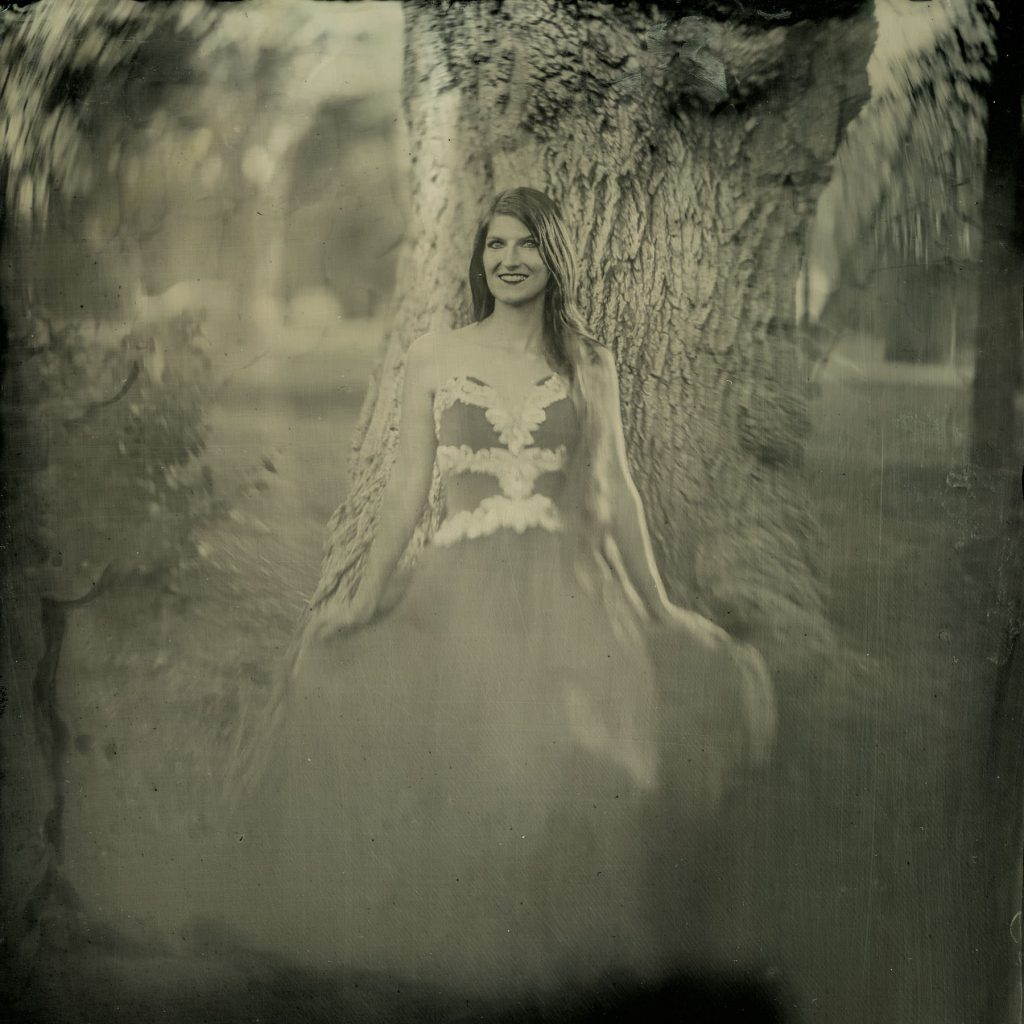
A wet plate tintype is real in a physical sense because it is an object I can hold and feel. It is also real in an optical sense because it reflects light and my eyes can detect an image. A digital image is not real in a physical sense because I cannot hold it in my hands and I cannot see it. The image can become real when I print it. Now it is a real object I can touch and feel and I can see the image from reflected light.
What about digital images projected on a computer screen? Are they real? Lets apply the grizzly bear test! Lets say a hungry grizzly bear is charging towards me. If I close my eyes what happens? Dinner is served! So the grizzly bear is real because it didn’t go away when I stopped looking at it. So now lets say I am looking at a picture of a hungry grizzly bear and I close my eyes. What happens? Nothing, because the digital image only exists when I look at it. It is not real!
But if the digital image is not real what is it? I think it is latent. Latent means existing only in potential and requiring activation to be seen or experienced.

Final Thoughts
Real things exists in multiple dimensions. They occupy space and time and have a physical existence. A digital image is one dimensional and only exists as light perceived by our optical nerves. They exist inside our minds and can only be experienced on one level. A tintype can be held in your hand, it changes as you move it around; it can be passed down to multiple generations and does not require a machine to be experienced.
So if you’ve been intrigued by the thought of what is real, and you want to experience REAL photography, then you should Contact Me to create some real portraits of you or your family!